Lord of the Flies (2026) Are We Really Better Than These Boys?
I didn’t expect to like this. At all. The earlier film adaptations of Lord of the Flies never really hit for me, and I honestly thought this new four‑episode limited series that aired on Netflix would just be another dusty assignment from summer reading season. Instead, it knocked me sideways and made me look at the story in a completely different way.
This version shifts Lord of the Flies from “horrifying classic you were forced to read too young” into a very 2026 mirror about how quickly we can slide into chaos when nobody is watching.
Back to school with Golding
The series sticks closely to William Golding’s 1954 novel, and you can feel his background in every frame. Golding was a teacher in Cornwall who spent years around boys like the ones on this island, and then went off to fight in World War II and see what people are actually capable of when the rules fall away. That combination — the classroom and the battlefield — is all over this story.
He famously said that “man produces evil as a bee produces honey,” and you can feel that thesis baked into every decision here. This is not a story about some random island suddenly turning these kids bad. The point is that the darkness was in them from the start; the island just stripped away the uniforms and the supervision so we could see it clearly.
The series also leans into the original inspiration: Lord of the Flies was written as a rebuttal to the earlier adventure novel The Coral Island, where shipwrecked British boys build a wholesome little Christian utopia. Golding basically said, “That’s cute, but that’s not how real kids behave,” and this adaptation makes that contrast very obvious.
Plot in a nutshell (no spoilers beyond the book)
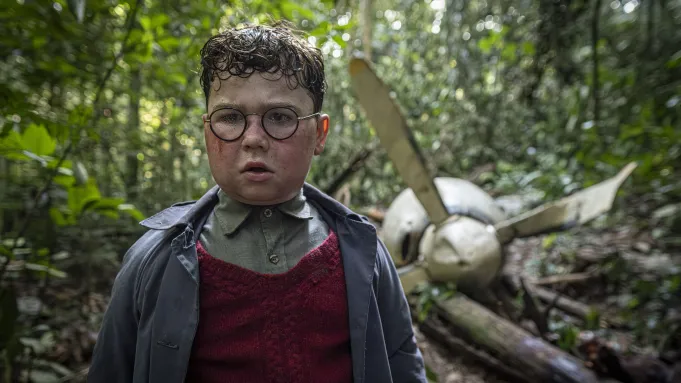
We’re set in the 1950s. After a plane crash, a group of boys ages roughly six to twelve end up stranded on a tropical island with no surviving adults. The initial plan is simple: elect a leader, keep a signal fire going, hunt for food, and wait to be rescued.
Ralph (Winston Sawyers) gets picked as chief. Piggy is the brains of the operation but, because this is essentially middle school with palm trees, nobody is lining up to follow the chubby kid with glasses. Then Jack arrives with his choir boys, marching in like dark little soldiers, and you immediately feel the sinister energy he carries.
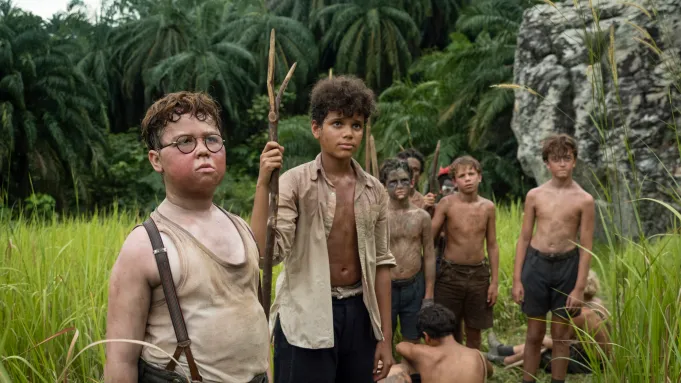
From there, all the things that ruin group projects ruin the island: power struggles, people feeling unheard, jealousy, boredom, and the thrill some folks get from hurting others. The boys slowly split into two camps — Ralph/Piggy/Simon on one side and Jack and his hunters on the other — and the show tracks the way tiny slights turn into full‑on savagery.
If you’ve read the book, you know where this is headed: a dead child, a rock, a pair of glasses, and a rescue that comes too late to put the innocence back where it came from.
Performances and characters
Ralph – the decent kid who still wants to be liked
Winston Sawyers is a standout in his first role. Ralph is physically strong, charming, kind of a head taller than the other boys, and clearly the “natural” leader type. But what makes him interesting is how often he caves to peer pressure. He wants to be good and he wants to be liked, and those two things are not always aligned on this island. The show really leans into that tension.
Piggy – my forever favorite
Piggy has always been my favorite character, and this version doubles down on why. He represents knowledge, science, logic, and a stubborn sense of right and wrong. He’s mouthy, he’s sharp, and he refuses to bend himself into something more palatable just to fit in. His friendship with Ralph is the last thin thread of humanity on the island, and the series treats that bond with the weight it deserves.
I also loved the choice to use his real name, Nicholas, in the beginning and later “Nicky” once Ralph finally starts to grow a spine. It sends a message that Ralph is finally seeing him as a whole person, not just the punchline.
Simon – intuition and surrealism
Simon (Ike Talbot) is where the show gets weird in a good way. He’s epileptic, intuitive, and deeply plugged into the island’s energy. Whenever he drifts into his episodes, the visual language shifts: the lush greens give way to intense reds and oranges, and the island almost feels like it’s breathing along with him. Simon knows, long before anyone else, that this is heading toward madness, but he’s too passive and too ignored to stop it. His fate hurts even if you know it’s coming.
Jack – the Draco Malfoy audition tape
Jack (Louis Ashbourne Serkis) is pure pride, ego, and resentment wrapped in a choir robe. On paper, he isn’t built to be the monster he becomes — he wants fun, freedom, and a break from being told what to do. But exile, humiliation, and the thrill of power twist him into something terrifying.
You can see flashes of the “nice boy” Simon remembers, which makes his descent more chilling. And the show smartly gives him a right‑hand man in Roger, who’s even more sadistic. Jack doesn’t create that cruelty; he amplifies it and gives it permission. That dynamic — the charismatic bully plus the true monster behind him — feels very 2026.
Direction, worldbuilding, and that wild score
Director Mark Munden and writer Jack Thorne are the perfect pair for this material. The series was shot in Malaysia, and the island feels both beautiful and hostile — like paradise that’s slowly rejecting its guests. Their previous collaborations on National Treasure and Help showed they could do morally messy, character‑driven stories, and that experience shows here.
The color grading is intentionally unconventional. As order breaks down, the world gets harsher, more saturated, and more surreal. By the final episode, everything feels animalistic: hunter vs hunted, predator vs prey.
The score is going to be divisive, but I loved it. It starts airy and whimsical when the boys are still in “school trip gone wrong” mode, and then evolves into something primal and pounding as the bloodletting starts. It’s never just noise; it’s tracking their descent step by step. I’m usually allergic to gratuitous scoring, but here it absolutely serves the story.
Casting deserves its own shout‑out. Nina Gold, who also cast Game of Thrones and Baby Reindeer, held open calls for these roles, and most of the boys are complete newcomers. You can tell. There’s a rawness to their performances that feels more like watching kids implode in real time than polished child‑actor work.
What this adaptation is really saying
Watching this as an adult, the story hits very differently than it did when we were reading it in school. Back then it felt like a horror story about “bad kids on an island.” Now it feels like an honest commentary on human nature and how fast things fall apart when structure and accountability vanish.
The show keeps coming back to one question: Are humans naturally savage, or are we essentially good but corrupted by our circumstances?
Golding clearly believed the darkness is already in us, especially in comfortable, elite British boys raised to think the world belongs to them. The series doesn’t completely answer the question for us, but it does force you to sit with the idea that none of us are above descending into our worst selves if the conditions are right.
In 2026, when cruelty online is often treated like a sport, Jack’s line about being “bored of worrying about being cruel” feels less like a period detail and more like a thesis statement.
Final thoughts – Sweet P rating
As an adaptation, this Lord of the Flies limited series is sharp, unsettling, and surprisingly emotional. It honors the original text while using modern craft — surreal visuals, an unnerving score, and very raw performances — to make the themes feel annoyingly current.
On the Sweet P meter, I’m giving this 4.5 sweet peas out of 5. It’s impeccably done, it’s thoughtful instead of gratuitous, and it gives us plenty to argue about in the comments.
If this doesn’t get some awards buzz, I genuinely don’t know what will.
Talk to me, Sweet P’s
- Do you think humans are naturally savage, or basically good until systems fail us?
- Did this adaptation change how you feel about the book you were forced to read in school?
- And should we do a full “Back to School” series and cover more shows and movies based on the books we grew up on?
Drop your thoughts below, like and subscribe if you enjoyed this breakdown, and let me know what adaptation you want us to tackle next.